
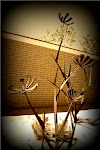




The second of a forecast three storms is blowing in, coming from the pass to the west. The leading edge is a dark grey line advancing toward my back yard. In front of the leading edge of the storm, the sun is shining, but behind the facade it is cold, windy, and wet.
It's been snowing on the surrounding mountains for several hours, but so far, we've only seen light sprinkles on the ground. The third storm is due in either later today or tomorrow, so we'll see what, if anything, arrives to give the parched desert another winter drink.
I like the rain, but not the cold that accompanies it. The wind driving the storm into the valley whips against the metal shed housing my next door neighbor's outside water heater, and the ensuing racket is enough to wake me from a sound sleep. One of these days, when I know they're away, I'm going to take some plywood and box that sucker in. I doubt they'll ever know the difference, but I sure will!
Sunday, January 6, 2008


Friday, January 4, 2008
On Any Given Page
A friend presented me with a Christmas treasure: an old book, a really old book, entitled English Composition in Theory and Practice, published by The MacMillan Company in 1909. I’ve known the name Henry Seidel Canby, Ph.D. since my college days, and it is his name at the top of the authorship list, followed by four colleagues “of the Department of English Composition in the Sheffield Scientific School, of Yale University.”
I’ve been reading steadily since I brought the book home. The book includes both instruction in English composition, much the same today as it was a century ago, and application of the composition skills. The application includes a fascinating collection of essays with an eclectic range of authorship, most of which are obscured by the plethora of paper that comprises today’s society, but which are priceless in the reasoned, timeless analysis of global topics that remain at the forefront of societal concerns a century later.
I particularly enjoyed reading an address delivered by Woodrow Wilson before the Phi Beta Kappa Society of Yale University, entitled ‘The Training of the Intellect.” In his words, I hear my educational philosophy reflected and realize that the same issues he addressed in his speech that day could be my own words to my colleagues a century later: how a student feels about himself while at school is less important than how well educated the student is. The job of the educational institution is academic; if, along the way, a student also builds character, so be it, but that is NOT the primary job of the educational process.
“Mr. Toastmaster, Mr. President, and Gentlemen: -- I must confess to you that I came here with very serious thoughts this evening, because I have been laboring under the conviction for a long time that the object of a university is to educate, and I have not seen the universities of this country achieving any remarkable or disturbing success in that direction. … Is it not time we stopped asking indulgence for learning and proclaimed its sovereignty? Is it not time we reminded the college men of this country that they have no right to any distinctive place in any community, unless they can show it by intellectual achievement?”
Further in his address, Wilson defines the element of character, remarking that “I hear a great deal about character being the object of education.” Wilson asserts that “Character, gentlemen, is a by-product. It comes, whether you will or not, as a consequence of a life devoted to the nearest duty, and the place in which character would be cultivated, if it be a place of study, is a place where study is the object and character the result.” He concludes that “The object of a university is intellect; as a university its only object is intellect.”
I smiled as I read his words that also challenge the scholars of a hundred years ago to think before they act: “That is the function of scholarship in a country like ours, to supply not heat, but light, to suffuse things with the calm radiance of reason, to see to it that men do not act hastily, but that they act considerately, that they obey the truth.” Time for today’s spin doctors and instant media analysts to become history, rather than a driving force in today’s world.
The truth is that all people need to be educated, but not all people need the same education. This basic premise is ignored in the No Child Left Behind frenzy, as the unique needs of the student population are replaced with generic non-academic curricula that presumably meet the needs of all students at all times and in all classrooms, but which actually meet the needs of very few students in very few classrooms at any given time.
Without the basic educational tools, the foundation of reading, writing, speaking, listening, and thinking, there is no “education,” there is simply behavioral training. Students who cannot read and understand the written word, students who cannot write a basic sentence or orally articulate a basic idea, students who cannot perform basic, functional mathematical computations, students who cannot think for themselves, are students who cannot succeed past grammar school level. They cannot be educated because they have not mastered the basic core knowledge necessary to go beyond the elementary stages of the educational process. They may have been trained to function as students in whatever way that designation is currently publicized by the media, but they are not academically prepared, they are not intellectually engaged, they are not adequately educated.
Wilson ends his speech with stirring passion: “… if the Faculties in this country want to recapture the ground that they have lost, they must begin pretty soon, and they must go into the battle with their bridges burned behind them so that it will be of no avail to retreat.” I feel the same way about No Child Left Behind: if we want to educate students for what lies ahead, we have to go back to required mastery of the foundations of learning, actual knowledge of key academic concepts and skills, and hold students accountable for learning, rather than apologizing for and excusing their failure.
As a nation, we either believe in educating our citizens or we don’t, and if we believe that all citizens need an education, then we have to demand that they get it. We cannot give it to the student as it has to be earned, and education requires equal effort from the educational institution and the individual student to achieve. We cannot say let’s not leave any child behind and then devise a system that leaves the majority of them unable to read, write, speak, listen, and think as the culminating achievement of our educational process.
Thursday, January 3, 2008
Life's Journey
I gave up on New Year's resolutions a long time ago, but I believe firmly in life resolutions, which have led to some major decisions in my life along the way. This year, the life resolution is to clean up the detritus that I don't want someone else to deal with when I'm not here to do it myself.
If the journey of a lifetime begins with a single step, extending the idea, cleaning the garage begins with the first action.
Yesterday, I drove to JT and dumped the last of the construction detritus, thus freeing the back of the truck to receive the detritus from the garage, of which there is plenty. I had stored a few things in the guest room that needed to be donated to charity, along with some clothing and other items that were in the garage. I also had refuse that needed to be taken out to the curb, so that's where I began.
It will take many weeks of consistent determination to make headway, but that's the plan. I've put it off as long as I can, still don't have answers about all of the teaching materials, but I'll leave that to last and work my way around those boxes. It's difficult to assess 30 years of teaching materials with eyes that are looking at the very real need to downsize. By the time I work my way through the rest of the boxes, I'll have that answer.
There is shelving to be installed on the walls for that which is going to be saved. I'm not sure what that will be, if anything, but before I can attack the boxes, I have to have new boxes and packing material, as well as a place to put what stays. On the way home from the trip to empty the truck of the first load, I'll stop by Lowes and pick up the screws I need for the installation of the shelves and get that part of the job done first, which should provide the incentive to continue.
Tuesday, January 1, 2008
Property Rights
The kids got new bikes for Christmas. Because their parents park in their driveways, they are using my drive as a launch pad for "races" and a turn-around. The bikes have training wheels, so they don't go very fast, but they are also riding the bikes into the street without looking to see if the roadway is clear.
Since Christmas morning, I've tried to keep quiet about the constant use of my property for their bike riding, but enough is enough. I've gone outside for the second day in a row to direct them not to ride onto my property, to go to their own homes and ride in their own driveways. Today, the little guy assured me that they'll be quiet and not disturb me: they're just having fun.
No, I told them, you may NOT ride your bikes on my driveway. Go home and ride your bikes at your house.
They did leave--again--and they'll be back again. School resumes maybe tomorrow, so perhaps it'll become a non-issue. Meanwhile, I'm back to contemplating a gate across the driveway.
Personal Resolve
The "astrology team" at MSN offers 3 resolutions for the first day of the rest of your life, so I've borrowed them to clarify my own resolve.
First resolution: Get your own life in order — NOW. Whatever is uncertain, firm it up. Pay off as many debts as you can, and avoid running up any new ones. Start setting aside a little nest egg for yourself, and clear up any tension there may be between you and friends or family members to improve the mood.
Response: This is pretty much how I live my life, but how do I persuade others to do likewise? My "village" is guilty of the affluent life style, a life style that all too often is WAY beyond their means. I'm not.
Second resolution: Don’t depend on anyone but yourself to solve your problems. By taking matters into your own hands, you will be able to enact change in your life and in the lives of those close to you — if you want something done right, do it yourself! If you’re dissatisfied with your life, work to change it, perhaps by joining one of the grassroots movements that have been popping up like mushrooms all over the world.
Response: I've been the responsible party for the past 40-something years, pretty much doing whatever it takes to acquit myself with honor. Unfortunately, being a self-sufficient, non-conforming member of the "village" is not what others expect, with the result being that I am (perhaps) too independent, too emotionally distant, too self-sufficient. What I've also learned is that change isn't good or bad, it's just different, but the impact of the changes I make on others needs to be part of the decision-making process before I implement the change. All too often living with the change is worse than accepting the status quo.
Third resolution: Get involved. What cause appeals to you the most? Is it world peace, health and fitness for all, sustainable energy, or perhaps the rights of the weak, such as children and animals? Doing good for others will give you inspiration in other areas of your life, and overcoming obstacles will give you a sense of pride and accomplishment. Now is not the time to back down from a challenge — you could surprise yourself with how successfully you dealt with a difficult situation.
Response: I've given of myself for the past 40 years until there isn't much left for anything other than a small circle of family, friends, and responsibilities. My best efforts over the years have resulted in censure more often than praise because other people don't like those who do more than they do, or do it better or without regard for the extrinsic payback. Up until 10 years ago, I thought I had a lot to contribute to the world, but people and events convinced me that is not the case. I moved in another direction, leaving self-serving altruism to those who need it to build their resume or their own self-esteem.
Summary: I'm not a bad person, but I could be a better person. I can do more, but I already do more than what I advertise to others. I can change myself, but I cannot change others, so what difference does it make if I change? Why not accept that this is who I am, this is what I do/don't do, and if that works for you, then it works for me, and there is an us. If I'm not a person you want to share your time, space, or self with, or if you aren't a person I want to spend my time, space, or self with, then let's move on. It's not all about you, it's also about me, and I need to have as large a voice in my life as others presume to have. There's a difference between making decisions that affect me--and making decisions for me. When I have no voice, I have no life, so if that bothers you, then either deal with it or not, but don't try to make me take your journey: I have my own journey.
It takes a long life to learn the lesson that each of us does the best we can with what we have. As my mother used to caution me, "You can't put an old head onto young shoulders." Today, I'm an older head on older shoulders, so I understand that some people have more than others, intrinsically and /or extrinsically, but we use the tools we have, as well as what we learn as we go along, to make it through one day at a time. Sometimes life works for us, and other times it doesn't, but if we give it our best effort every day, chances are we'll have more workable days than not.
Subscribe to:
Posts (Atom)